Search This Blog

Tuesday, March 22, 2016

Kirchtag in Eberndorf

A small Village, just outside of Bleiburg, celebrates its annual Street Festival.
A seemingly never ending row of stands offers just about everything there is for sale.
From juicy Hams to well seasoned Cheese, hats and belts and woven baskets, and shawls and coats and dresses and Lederhosen for kids and adults, and wallets and shirts and T-shirts, and pants, and candies and cookies and bird houses and rabbit hatches,  and toys and toys and toys.


Here follows a tiny selection:


Little girls dresses, "Dirndls"
and
flags of all Nations


and hand-woven baskets


and Noah with his helicopter


Saturday, March 19, 2016

Hey, Quick ! We need a Saint

This is truly unbelievably “miraculous.”

The Pope has added one more to the long list of Saints which now adorn the Catholic Calendar.
“Mother Teresa”, the Nun who ministered to the very poor in India has performed, or so the Catholic church maintains, the two miracles required for the declaration of Sainthood.

It seems that the Vatican Committee charged with the investigation and final verification of Miracles has decided that Mother Theresa has indeed performed these two miraculous happenings.

The first miracle required for Beatification was confirmed by the Vatican as having occurred in 1998, one year after her death, when an Indian woman, named Monica Besra of Calcutta, who suffered from an abdominal tumor, placed a picture of Mother Teresa upon her abdomen.
“There was a beam of light, coming from the picture, which went directly to the cancer growing in my stomach. And my Cancer was cured.” so said Mrs. Monica Besra.
The doctors of the hospital where Mrs. Besra was treated insisted that the tumor was not cancerous, but definitely benign, and that the remission was due to the medical treatment and was in no way miraculous.
The Vatican Committee, who needed a “miracle” for the Beatification of Mother Teresa chose to believe Mrs. Besra and discounted the statements issued by the hospital and its medical staff.

A second “miracle” was needed for the Canonization of Teresa :
Here come the nuns of the “Missionaries of Charity”, the Order founded by Teresa, who quickly publish a flyer in which they make the following claim:
This second miracle performed by Teresa was the curing of a Brazilian man, on the 9th of December 2008, who suffered, so claimed the nuns, from an “incurable” brain tumor. When his wife prayed and asked for Teresa's help, her husband was cured instantly.
In fact, when the surgeon entered the room to perform an operation on the man's brain, he found him awake and in perfect health.
(One wonders why, confronted by an “incurable” brain tumor, a surgeon would try to operate)

So, now the Catholic Church has its required two miracles and as quickly as the ink can be put on paper and before it can dry, the Pope announces that on the 4th day of September 2016, Mother Teresa will become a Saint.
The normal five year waiting period between the death and commencement of Beatification had been reduced to three years, now there was no time to be lost. A person, famous all over the world was found in Teresa and some good news could help in covering all the horror news the Catholic church had been suffering from over the last number of years.

And on such flimsy evidence a new Saint is born.

Bertstravels
can only shake his head at such blatant trickery


Wednesday, March 16, 2016

The MAASAI are...

...a largely nomadic tribe moving with their herds of cattle in a constant circle from Kenya into Tanzania and back again. As long as the grazing for the cattle is plentiful they remain in location, building temporary huts within a large enclosed circle for their own and their animals' protection.
Some years ago, the then President of Kenya, Jomo Kenyata, (or was it his successor, Daniel Arab Moi ) invited several family elders to Nairobi, the Nation's Capital, in an effort to convince them to abandon their nomadic life, and to settle down in one area in order to farm the land. The Elders thanked him profusely for his hospitality, returned to their temporary homesteads and, as a token of their respect and gratitude, they sent him, as a gift, 1000 heads of cattle, thereby demonstrating their wealth. A clear indication of their satisfaction with their current mode of life.
Nothing further was said about the Maasai's settling down to become farmers.

Their staple food consisted of a mixture of cow's blood and milk.
On my question as to the location of their grave yards, my guide, a perfect English speaking Maasai explained to me that in the event of the death of a family member, a calf or cow is slaughtered and on this rare occasion, meat is consumed. The body of the diseased is taken away from the enclosure onto the veldt, where the animals intestines are placed next to the body and set afire.
Vultures can smell this burning meat from a distance of many kilometers and come for the feast.
In a short while all has disappeared.


Having visited several of their family enclosures one is left with the impression of an athletic, soft spoken, friendly people who live in the past, when compared to their brethren in Nairobi or similar places.


clothed in Toga like predominantely red coloured cloth, 
this small group is selling double sided spears
as well as necklaces made of  porcupine quills and colourful beeds.


They are, by and large, an attractive people
who seem to be stuck in the past
until...


...you notice a man in typical stance, wearing a modern, expensive watch on his right wrist.


...and here we have a beautifully decorated cell phone holder.

Reporting for "National Geographic" Timothy Baird, 
a Geography researcher asks:
Has the cell phone changed the Maasai for better or for worse ?
In the March 2016 edition he examines the impact 
this ultra modern "tool" might have on the semi nomadic life 
of  the people  living "off the grid".
Phones, says Geography Professor Baird, 
are a profound new tool for them.
There now is instant connectivity where none has existed before.
There now is access to weather reports, prices for animals 
and the possibility of young men flirting with young women, 
in a society where arranged marriages of young women to older men is still the tradition.
Cell Phones, so Baird, can store money, which has introduced Maasai to mobile banking.
Discussion groups, arranged by Professor Baird, amongst groups of Maasai revealed that Maasai men preferred to use the photographic feature on their phones to photograph ( yes you guessed right ) 
women and cows.
(to place these two preferred photographic subjects into proper perspective, it must be pointed out that cows are indeed a most important aspect of a Maasai's life. They determine the individual's and his family's wealth and standing within the community.
Is this modern tool diluting their historically rustic culture ?
The Maasai themselves see this development positively.
They see the cell phone as impowering rather than intrusive.

Cell phone picture taken from National Geographic Magazine
all other pictures taken by "Bertspix"


Tuesday, March 15, 2016

The Emperor of the Ham elected :

Two postings ago I told you about the "Festival of the Ham" 
( the Schinkenfest )

Now the deed is done, the Emperor elected by the people.

Hans Piko, the Bleiburgian Farmer, per excellance, triumphed over many compeditors.

So, there he is, 


Hans  Piko is not just "a farmer" ! Hans is a "passionate farmer !"
Each Tuesday, as regular as clockwork, he puts up his stand in Bleiburg, on the main square
and offers his product for sale.
Among the finest cuts of beef and veal there is of course his Ham.
He also makes sausages and bakes delicious bread.


Here is the "crowned" Hans.
I think Hans should have a huge jewel studded crown of a real Emperor


"The People elected their Emperor"

The local Newspaper shows Hans and his two closest competitiors.


The Saddlebilll Stork

I recently posted a picture of the Saddlebill Stork. Now I found a better one in my collection which shows the yellow saddle much better.


I must admit, though, that the other one, showing this stork in the tall reeds is, photographically speaking, the more interesting image.


Sunday, March 13, 2016

The "Ham Festival"

Each year Bleiburg celebrates the "Schinken" (Ham) by organizing the "Schinkenfest"  (Ham Festival).
Producers of this delicacy come from all over the District to place their product for sale, for tasting and finally for voting the best.
Each producer puts up a stand within a large tent, where he/she may sell their home made "Schinken".
Taste bits are offered to everybody and then it comes to the vote by ballot.
The winner may call himself the "Schinkenkaiser" 
                          ( the Ham Emperor ).
We are not just talking of the King of Ham !
This is the Emperor of Ham who will be crowned each year.
Don't for a minute think that this title does not dramatically improve sales! You bet it does:
So here are a few pictures of this annual celebration of great tasting pork..


Here is the Family Ribeschel, who garnered the coveted title of Emperor of the Ham in 2015
 They would probably be disappointed if they could not repeat in 2016


One of the many competitors to the Ribeschels.


A good slice of home baked bread and a large chunk of "Reindling"
belongs to delicious ham.


From as far away as neighbouring Slovenia, 
they bring their product
in the hope to be elevated to "Emperor of the Ham"


If this does not make your mouth water, 
you probably have never tasted 
Ham from Unterkärnten ( Lower Carinthia)


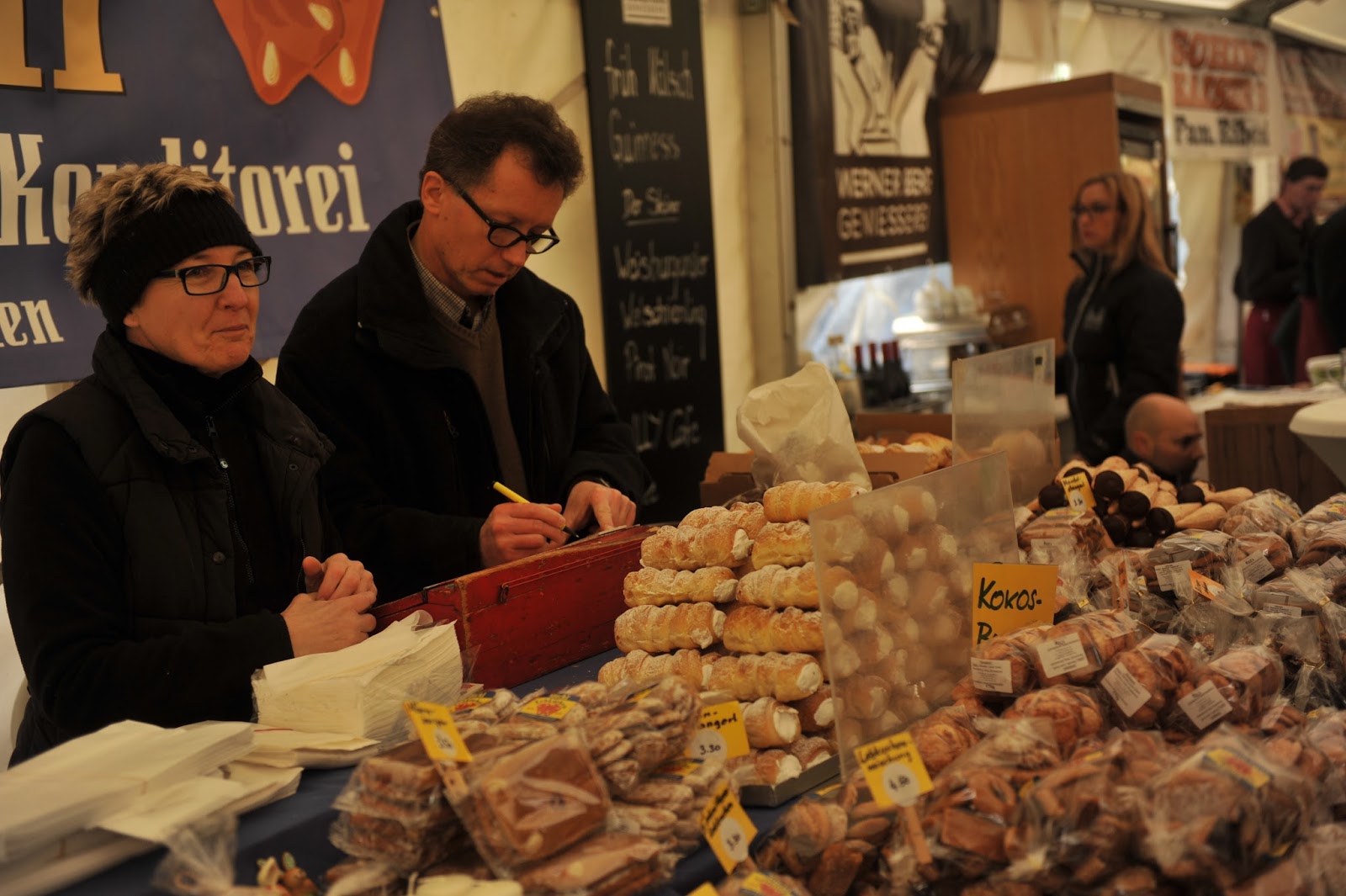
Gerhilde and Michael, from the Sweet Bakery (Konditorei) Stöckl
don't miss a bet to offer their products for Sale.


Andreas Bernik and his lovely wife operate our favourite Bar:
The Geniesserei ( the Enjoyery)
They too have a stand amid all the Ham 
where they supply much called for "liquid refreshment"


THIS IS THE "SCHINKENFEST"
IN BLEIBURG, LOWER CARINTHIA!

WHAT A BLAST !!!

Friday, March 11, 2016

Spell check ?

The "Spell Check" on my e-mail either has a great sense of humor, or it is in dire straights in respect of translations from German to English:
When in my e-mail I use the words: "Bleiburg" ( the town in which I live ) or "Klagenfurt" ( the Capital of Carinthia) it underlines these words in red, telling me that there is a spelling error.
Usually I ignore this message, because I know how to spell these names.
The other day I decided to check what "corrections" my spell check would suggest.
Here are the results.  No foolin' that's what my spell check suggests as alternatives to 

Bleiburg:  Bedbug, Bluebird, belabour..

I can accept Bluebird.  But Bedbug?

Klagenfurt:  Gelignite, Jackknifed, Golconda, Collectivity.

If I am  not mistaken, Gelignite is an explosive, and "jackknife" is what a truck plus trailer may do in a accident. Also, when I was a kid, I had a jackknife, with a wooden handle...

For Bleiburg, at least, my spell check looked for words starting with the same letter.
but Gelignite or jackknifed instead of Klagenfurt ?????

I am now convinced that there is a little man sitting in the Spell-Check department of my computer who has a weird sense of humor, tries to find the most outlandish Spell-Corrections and is killing himself laughing at my amazement.


Bertstravels
has found a new computer game.